Oh Deer Reindeer Design: A Crafter’s Review
As a designer who has spent countless hours behind the needle and in front of digitizing software, I approach every new graphic with a specific question: will this actually stitch out well? When evaluating Oh Deer, Christmas Reindeer, Oh Dear, my assessment goes far beyond the cute factor. While the pun is undeniably charming for the holiday season, my primary concern as a professional is how this artwork translates from a digital screen to a tangible, stitched reality. For fellow Etsy sellers, apparel decorators, and makers, understanding the practical application of this design is crucial before committing it to fabric.
First Impressions and Visual Personality
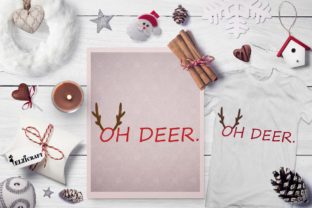
The immediate appeal of Oh Deer, Christmas Reindeer, Oh Dear lies in its playful duality. It balances traditional holiday nostalgia with modern humor, creating a mood that is festive yet approachable. Visually, the layout suggests a design that relies on clear silhouettes and expressive typography. As a graphics asset, it feels versatile enough to bridge the gap between nursery decor and adult apparel. However, when I look at the provided files—specifically the SVG, EPS, DXF, and 300dpi PNG—I am analyzing line weight and negative space. The vector formats (SVG and EPS) are particularly promising for those of us who need to manipulate the design for different applications, while the high-resolution PNG serves as an excellent reference for color matching or creating printable mockups for client approvals.
This design naturally belongs on items that invite interaction. It isn't a formal, stiff motif; it begs to be placed on cozy, tactile surfaces. The personality of the reindeer and the accompanying text suggest a relaxed, handmade aesthetic rather than mass-produced corporate merchandise. For a craft business owner, this distinction is vital. You aren't just selling a product; you are selling a feeling of whimsical comfort.
Real-World Application: The Holiday Sweatshirt Test
To truly evaluate this machine embroidery design, I mentally place it in a real-life production scenario. Let’s imagine preparing a custom embroidered sweatshirt for a boutique holiday collection. This is where the rubber meets the road. A sweatshirt presents unique challenges: fleece backing, stretchy knit fabric, and a curved surface area.
In this context, Oh Deer, Christmas Reindeer, Oh Dear performs best when treated as a focal point rather than an all-over pattern. If utilizing the design for sweatshirt embroidery, I would prioritize the vector files to ensure clean edges if converting to an applique design. Appliqué is often superior for large graphics on knits because it reduces stitch density, preventing the dreaded "bulletproof" patch effect that makes garments stiff and unwearable. If stitching directly, the design needs to be evaluated for satin stitch versus fill stitch balance. Satin stitches provide that classic, shiny embroidery look but can pull on stretchy fabrics. Ensuring the design has adequate underlay or is paired with a cutaway stabilizer is non-negotiable here.
For a tote bag design or tea towel, the considerations shift. These items typically use woven cotton or canvas, which are much more stable. Here, the intricate details of the reindeer’s antlers or facial expression can shine without fear of distortion. The 300dpi PNG file becomes incredibly useful in this stage for creating heat transfer vinyl (HTV) versions using the DXF file for cutting machines, allowing you to offer mixed-media products alongside traditional embroidery.
Navigating Fabric Limitations and Hoop Sizes
Not every project is a safe bet for this specific artwork. Through experience, I have learned to identify where a design might fail. With Oh Deer, Christmas Reindeer, Oh Dear, caution is required for small hoop sizes. If the design contains tiny lettering or delicate facial features, scaling it down below 4 inches may result in lost detail or thread breaks. Always check the minimum recommended size before resizing.
Textured fabrics like terry cloth or boucle also pose a risk. The pile can swallow running stitches and obscure fine details. If you intend to use this for baby embroidery on a plush blanket or hooded towel, you must use a water-soluble topping to keep the stitches visible. Conversely, on thin fabrics like quilting cotton or lightweight linen, the stitch density must be monitored. Too many stitches in one area can cause puckering or even tear the fabric. Testing on scrap fabric that matches your final project weight is the only way to guarantee a professional finish.
Dark fabrics present another variable. Does the design rely on internal shading that disappears against navy or black? Or does it have a bold outline that pops regardless of background? Before listing a finished product in your shop, test the contrast. Sometimes, adding a white underlay or changing thread colors is necessary to maintain the visual integrity of the reindeer against darker holiday palettes.
Commercial Viability and Customer Trust
For creative entrepreneurs and digital product sellers, the value of Oh Deer, Christmas Reindeer, Oh Dear extends beyond the stitch-out. It impacts brand consistency and buyer engagement. Customers trust shops that present polished, realistic previews. Using the included high-res PNG and vector files, you can create accurate printable mockups that show exactly how the design sits on a cap, apron, or pillow cover. Misleading mockups lead to returns; accurate representations build loyalty.
Furthermore, consider the licensing. Before selling finished items or offering this as a digital embroidery file yourself, confirm the commercial terms. Nothing damages a craft business reputation faster than copyright infringement. Assuming the license permits commercial use, this design has strong potential for personalized gifts. The "Oh Dear" pun allows for customization—perhaps adding a family name or year below the graphic—which increases perceived value and justifies a higher price point for custom apparel.
Designer Notes for Successful Execution
Based on my evaluation, here are practical steps to ensure success with this design:
- Verify File Compatibility: While DXF, SVG, EPS, and PNG are included, always confirm your specific embroidery machine or software accepts these formats before purchasing. Convert vectors to embroidery formats (.pes, .dst, etc.) using reputable digitizing software.
- Stabilizer Selection: Match your stabilizer to the fabric, not just the design. Use cutaway for knits and tear-away for wovens. Never skip stabilizer to save money; it ruins the final product.
- Thread Color Contrast: Test thread colors against your chosen fabric in natural light. Screen brightness is deceptive. What looks vibrant digitally may appear muddy on beige linen.
- Mockup Accuracy: Utilize the 300dpi PNG to create true-to-life mockups. Avoid stretching or distorting the image in your preview photos. Show the design flat and on-model if possible.
- Detail Inspection: Zoom in on the vector files. Are there open nodes or overlapping lines? Clean up any vector artifacts before sending to your cutter or digitizer to prevent jagged edges.
- Wash Testing: If selling baby items or kitchen textiles, wash and dry your test sample. Ensure the design holds up to frequent laundering without fraying or shrinking disproportionately to the fabric.
Ultimately, Oh Deer, Christmas Reindeer, Oh Dear is a delightful addition to any holiday catalog, provided it is treated with technical respect. By understanding its behavior across different substrates and respecting the limitations of various hoop sizes, you can transform this digital graphic into a high-quality handmade product that delights customers and stands the test of time. Whether you are crafting for profit or creating a personalized gift, approaching this design with a maker’s mindset ensures the final result is as charming in thread as it is on screen.